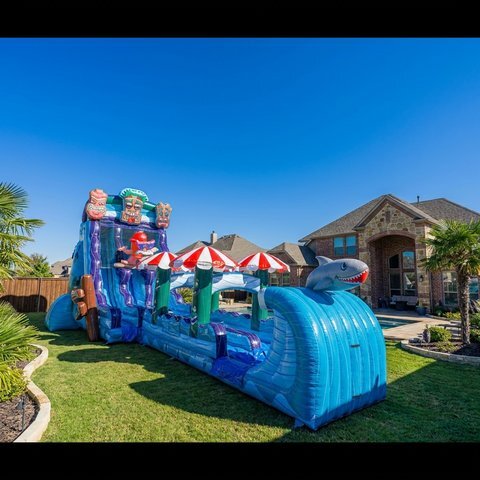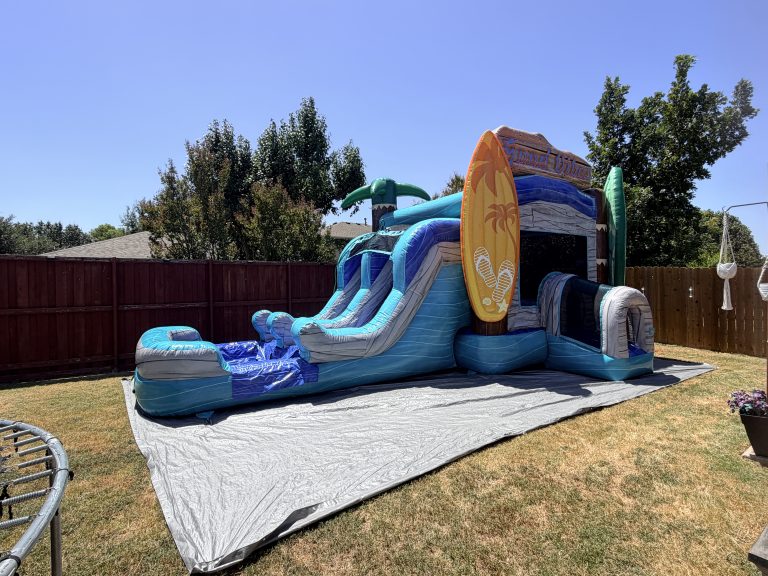
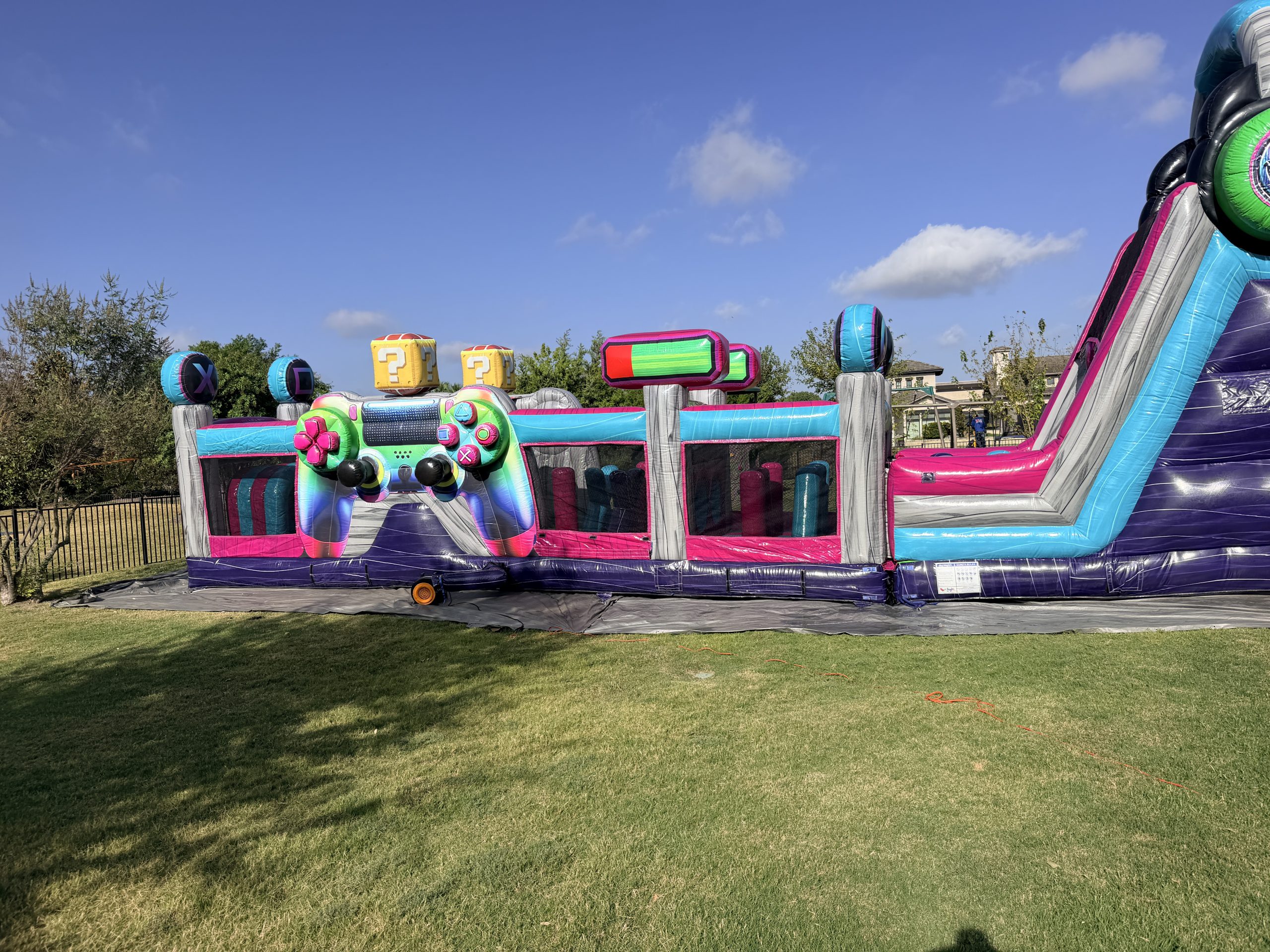
Do You Need a Generator for a Bounce House?
For most backyard parties, no. One blower on a normal household outlet, on its own circuit, is all you need. A generator becomes the answer when there is no outlet within a reasonable cord run, which usually means a park, a field, a church lot or a large venue, or when you are running several blowers and other equipment at once.
How a bounce house blower actually draws power
The blower is a simple centrifugal fan that runs continuously for the entire rental. The unit stays up only while the blower runs. Shut the power off and a bounce house settles to the ground in under a minute.
Typical residential blowers are in the range of one to one and a half horsepower and draw somewhere around six to twelve amps on a standard 110-volt outlet, with a brief higher surge at startup. The practical translation is simple: one blower on a dedicated 15 or 20 amp household circuit is comfortable. Two blowers on the same circuit often is not, and that is where problems start.
Bigger units and some water slides use two blowers. Combos with a slide sometimes do too. If you are renting more than one inflatable, assume more than one blower and plan power accordingly.
Why the cord run matters more than people expect
This is the single most common cause of a sagging bounce house. Electricity loses voltage over distance, and the thinner the cord, the more it loses. A blower running on low voltage pulls harder, runs hotter, and either underperforms or trips a breaker. The unit looks soft, kids complain, and everyone blames the inflatable.
- Use a heavy-gauge outdoor extension cord, not a household indoor cord and never a thin flat one.
- Use one cord. Do not chain two or three together to reach.
- Keep the run as short as you can. Most operators keep the total distance well under a hundred feet.
- Do not run the blower through a power strip or a light-duty timer.
- Keep the cord out of the walking path and away from standing water, especially with wet units.
- Outdoor outlets should be GFCI protected. If the GFCI keeps tripping, that is information. Stop resetting it and find a different circuit.
Also think about what else is on that circuit. Garage and patio outlets often share a breaker with a refrigerator, a freezer, or the garage door opener. Add a snow cone machine, a coffee urn or a DJ rig on the same line and something will give. Spreading the load across different circuits is the difference between a smooth afternoon and a mystery deflation halfway through cake.
When a standard outlet is fine
Almost always at a house. If your setup spot is within an easy cord run of a working exterior outlet, and that outlet is not shared with a heavy appliance, you are set. Point the crew at the outlet during the walkthrough and ask which breaker it is on so you can reset it yourself if it ever pops.
When you need a generator
- Public parks. Outlets are usually unavailable, unreliable or off limits.
- Open fields, farms and large lots where the nearest building is far past a safe cord run.
- School and church grounds, where exterior outlets may be locked, controlled, or already committed.
- Multiple units or multiple blowers, where household circuits cannot carry the total load.
- Front-yard or curbside setups at homes where all the accessible outlets are out back.
A generator has to cover the startup surge, not just the running load, so size it well above the combined running wattage of the blowers. Rather than guessing, ask your rental company what their specific blowers require. Many companies will bring a generator for a fee, which is usually the simplest path because it comes sized and fueled for the job.
Practical generator notes
- Plan fuel for the whole rental, not just the party. A blower runs the entire time the unit is up.
- Refuel with the blower shut down and the engine off, never while it is running hot.
- Exhaust is carbon monoxide. Keep the generator well away from tents, canopies, garages, open windows and anywhere people gather, and downwind if you can.
- Place it away from the kids’ path entirely, on stable level ground, and keep a barrier or distance between it and the crowd. Hot surfaces and curious hands are a bad combination.
- Generators are loud. Inverter models are noticeably quieter if noise is a concern for neighbors.
Parks take extra planning
If your party is at a public park, sort out power early. Many cities require a permit for an inflatable on park property, often along with proof of insurance from the rental company, and some restrict which areas can be used at all. Rules differ from city to city across North DFW, so call your city’s parks department or check their website weeks ahead rather than assuming what worked in one town works in the next. Ask specifically about power, because that answer usually determines whether you need a generator.
One safety note about power loss
If the blower stops, the unit deflates. It is not violent, but it is quick. Everyone should know the plan: get the kids out first, then troubleshoot. Teach children before they get in that if the walls start going soft they should move to the door and crawl out, not sit down or hide in a corner. An adult should be watching the whole time anyway, and should know where the breaker or the generator switch is.
The practical takeaway
At a house, a single working outlet on its own circuit with a heavy-gauge cord is almost always enough. Get a generator when distance, venue rules or multiple blowers make that impossible, and let your rental company size it. The two things worth doing yourself are checking what else shares your circuit and making sure your outlet is close enough that nobody is chaining cords across the yard.
InflatableTX is a family-run rental company serving North DFW, including Frisco, Plano, Denton, Lewisville, The Colony and Carrollton. If you are planning a park event or a setup far from an outlet, take a look at what we have available and mention the power situation when you reach out.