Can You Put a Bounce House on Concrete or a Driveway?
Yes. A bounce house can go on concrete, and plenty of them do. The difference is anchoring. You cannot drive a stake into a driveway, so the unit has to be held down with heavy sandbags or water weights at every anchor point, and it needs a tarp underneath to protect the vinyl. Done properly, it is safe. Done casually, it is one of the more dangerous things you can put in a yard.
Why anchoring is the whole conversation
An inflatable is a large, light, hollow object with a lot of surface area. Wind is the hazard that matters, and it is the factor behind nearly every serious bounce house incident you read about. On grass, stakes drive deep into soil and borrow the ground’s own resistance. On concrete you have no such option, so every bit of holding force has to come from weight sitting on the anchor points.
Sandbags work differently from stakes
Stakes are long steel pins driven at an angle through the anchor straps. A properly driven stake in decent soil holds a great deal.
Sandbags and water weights resist by mass and friction alone. That means quantity matters, placement matters, and shortcuts show up fast. Every anchor point needs a weight, not just the four corners. The weight belongs on the strap itself, sitting low and flat, not leaned against the side wall where it can slide. A bag near a strap is decoration, not anchoring.
How much weight is enough depends on the size of the unit and what the manufacturer specifies. Bigger units catch more wind and need more. This is a fair question to ask your rental company directly, and a good operator will tell you what their unit calls for and show up with it on the truck.
Wind is the line you do not cross
Manufacturers publish a maximum wind speed for their units, and it is lower than most people expect, often somewhere in the mid-teens to low twenties in miles per hour. Follow the number on your specific unit rather than a general rule. When wind reaches that limit, or when a storm line is moving through, the response is the same everywhere: get everyone out, shut the blower off, and let the unit go down. A ballasted unit on concrete gives you less margin than stakes in soil, so err early. North Texas weather can turn in twenty minutes.
Surfaces that work
- Concrete driveways, patios and sport courts. The most common hard-surface setups. Flat, clean, quick to dry. Watch the slope.
- Asphalt. Workable with caveats. It gets extremely hot in summer, and hot asphalt can mark vinyl and is unpleasant underfoot at the entrance.
- Pavers. Fine when level and stable. Uneven or loose pavers create pressure points under the floor.
- Artificial turf. Usually treated as a hard surface, because most turf sits on a compacted base that stakes cannot reach, and staking would damage the turf anyway. Weights, not stakes.
- Packed gravel or decomposed granite. Sometimes workable with weights and heavy tarping, but the loose stone is rough on the underside. Ask before you assume.
Surfaces that are genuinely not worth it
- Loose landscape rock and mulch. Sharp, mobile and hard on the floor of the unit.
- Sloped driveways. Driveways are pitched for drainage. A gentle grade is usually fine, but a real slope tilts the floor, pushes riders toward the low end and makes the entry step awkward and higher than it should be.
- Wooden decks and balconies. Load capacity, railing height and the total lack of a real anchor point make these a bad idea in almost every case.
- Garages, carports and anywhere with low overhead clearance.
- Anywhere close to a pool edge, a retaining wall, a drop-off or the street.
Protecting the vinyl and the concrete
Hard surfaces are abrasive. The bottom of an inflatable is coated fabric, and it will scuff, thin and eventually tear if it is dragged or bounced directly on rough concrete for hours.
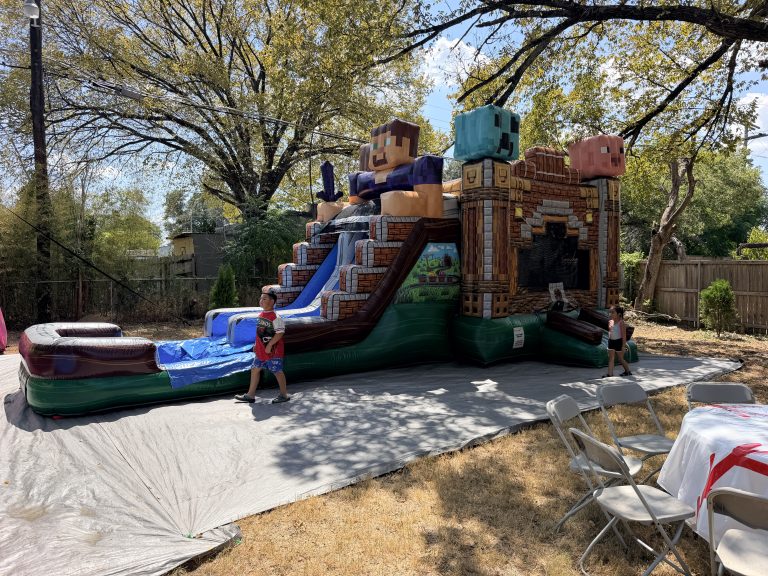
- A heavy tarp under the entire footprint is not optional on concrete. On rough or exposed-aggregate finishes, two layers is better.
- Nothing gets dragged. Units are carried into position and unrolled where they will stand.
- Sweep the area first. One screw, chip of glass or piece of gravel under the floor can put a hole in it.
- Plan the landing zone. Kids come out of the door fast, and on concrete they land on concrete. A mat or a strip of grass at the exit is worth arranging.
Heat deserves its own mention. In a Texas summer, concrete and especially dark asphalt get hot enough to be a real problem for bare feet and for anyone sitting alongside supervising. Shade over the area, an earlier time slot, or a wet unit changes the day completely.
What to check before you book
- Measure the flat part of your driveway or patio and leave clearance on every side.
- Look up. Eaves, basketball goals, wires and low branches all count.
- Confirm your rental company brings weights, and enough of them. Some companies do not carry them and will not set up on hard surfaces at all.
- If you are in an HOA, or the unit will sit near a shared drive, sidewalk or any public space, check the rules with your HOA or your city rather than assuming it is fine.
The practical takeaway
Concrete is a perfectly reasonable place for a bounce house when three things are true: the surface is flat and swept clear, there is a tarp under the whole footprint, and every anchor point carries real weight. Grass is still easier, because stakes are stronger and the ground is softer and cooler. But if a driveway is what you have, say so when you book so the crew arrives with sandbags on the truck instead of a bag of stakes.
InflatableTX is a family-run company serving North DFW, from The Colony and Frisco to Denton, Plano and Carrollton, and we set up on driveways regularly. If you want to see what would fit your space, take a look at the bounce houses and slides we rent.