What Does Supervising a Bounce House Actually Involve?
Supervising a bounce house means one sober adult standing outside the unit, near the entrance, watching the floor the entire time it is inflated and in use. Not glancing over from the grill. Not sitting inside it. Standing where they can see every rider and intervene in about two seconds. Most inflatable injuries are collisions and falls between children, and almost all of them happen in the moments when nobody was really watching.
What the job actually is
People imagine supervision as passive. It is not. A person doing it properly is doing four things on a loop, minute after minute.
They are counting. How many kids are inside, and is that within what the unit is rated for. They are sizing. Are the biggest and smallest riders in there together right now. They are reading the floor. Is anyone getting cornered, piled on, or bounced off their feet repeatedly. And they are watching the doorway, because the entrance is where the traffic conflicts are and where a kid is most likely to come out fast and land on something hard.
That is genuinely occupying. It is not compatible with hosting, cooking, or a long conversation. Which is why the practical answer at most parties is a rotation: adults take twenty or thirty minute shifts and hand off deliberately, out loud, so there is never a gap where everyone assumes someone else has it.
Where to stand
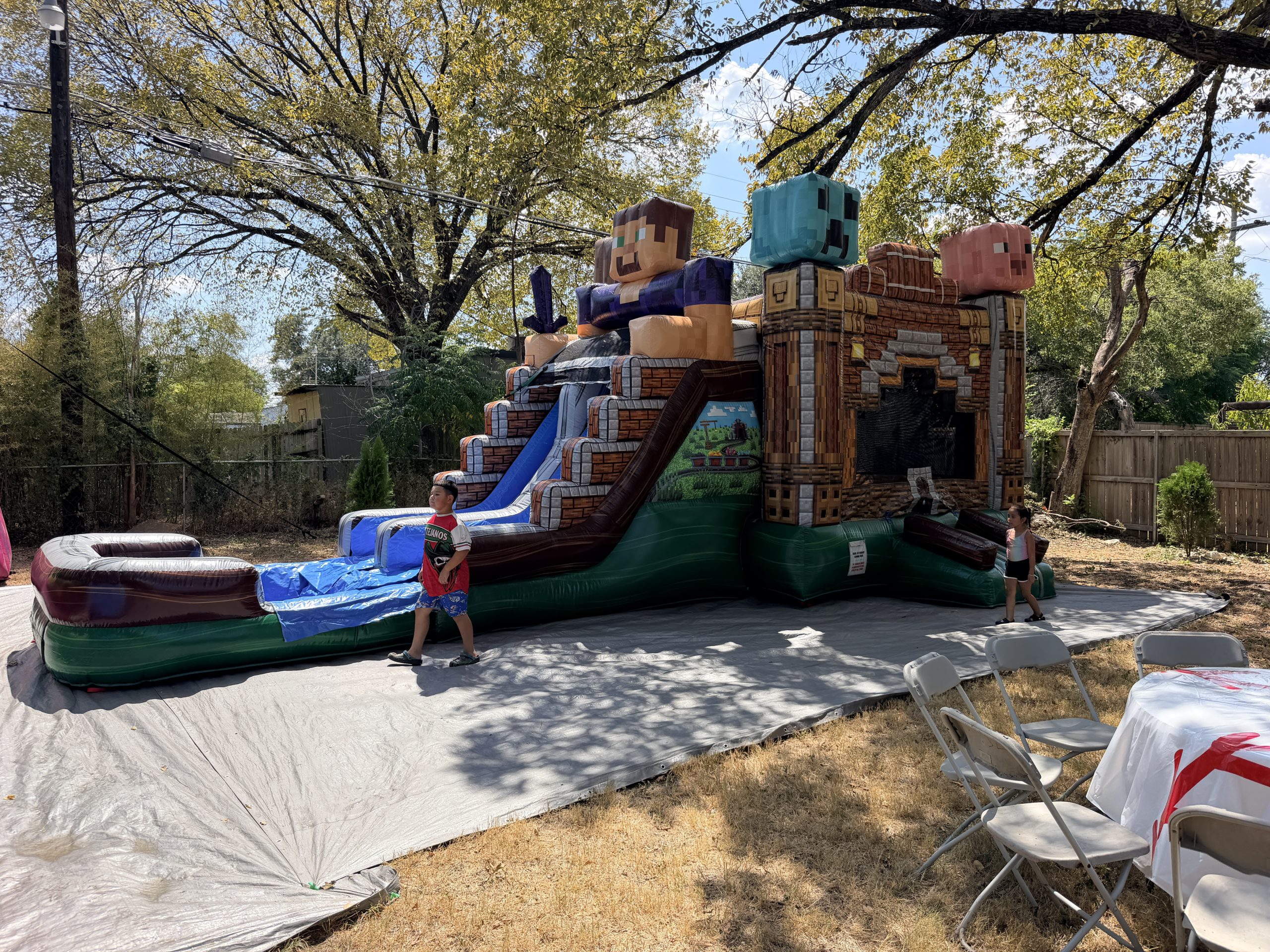
Outside the unit, at the entrance side, far enough back to see the whole bounce floor through the mesh. If the unit has a slide, you need a position that covers both the bounce area and the slide runout, or you need a second adult. From inside the unit you cannot see anything, and you become an obstacle. From the patio you are too far away to matter.
If the party has a big age spread, the most useful place to stand is right at the entrance, because your main tool is controlling who goes in and when.
Separate by size, not by age
This is the single most effective thing a supervisor does. A nine-year-old and a three-year-old on the same bounce floor is not a fair fight. The heavier child’s landings throw the smaller one off balance, and a fall into another child’s knee or head is how most serious inflatable injuries happen.
Run it in waves. Little kids get the floor for a stretch, then big kids, then little kids again. Nobody misses out, and you have removed the main injury mechanism.
The rules that need enforcing
- No shoes. Socks are usually fine, bare feet are fine, shoes are not.
- No glasses, jewelry, hair clips, or anything hard in pockets. Keys and phones out.
- No food, drinks, gum, or candy inside. Choking risk on a moving floor, and it ruins the vinyl.
- No flips, somersaults, or wrestling. Neck injuries come from flips.
- No climbing the walls, hanging on the netting, or sitting on the roof line.
- No piling on, no dogpiles, no dragging smaller kids around.
- No toys, balls, or sticks brought in unless the unit came with them.
- Nothing slippery. No silly string, no sand, no water on a dry-only unit.
- No pets inside. Claws and vinyl do not mix.
- Exit means exit. Kids sit and slide out at the entrance, they do not jump out over the wall.
Say the rules once, out loud, to all the kids at the start. Then enforce them consistently. Kids test the boundary once and settle if the answer holds.
Why an older sibling is not a substitute
A twelve-year-old can watch a bounce house. They cannot supervise one, and the difference matters. Supervision means having the standing to tell an adult guest’s child to get out, being willing to make an unpopular call, recognizing that a kid who got clipped in the head needs an adult now, and having the authority to shut the whole thing down when the wind picks up. A child does not have any of that, and it is not fair to put it on them.
The same goes for the honorary version of this among adults. If four parents are loosely near the unit, nobody is supervising. Name the person who has it.
The blower, the cord, and the breaker
The unit stays inflated because a blower is running continuously. That means a few practical responsibilities.
Keep the blower and its cord clear. Kids should not be near it, and nothing should sit on the intake. Do not plug anything else heavy into the same circuit. A snow cone machine or a second blower on one household circuit is a common way to trip a breaker mid-party.
Know where your breaker panel is and which breaker feeds that outlet before the party starts. If the power drops, the unit will sag over a minute or two. That is not an emergency if you handle it calmly. Get the kids moving toward the entrance right away, because a deflating unit can trap someone under the walls. Then find the breaker.
The weather call
The supervisor owns the weather decision, because they are the one outside looking at the sky. Watch for wind picking up, tree movement, a dark line on the horizon, and any thunder at all. Every unit has a manufacturer wind rating, and it is lower than people assume. If the wind is gusting and the walls are moving, get the kids out and let the operator know. If there is lightning anywhere nearby, the party moves inside regardless of the inflatable.
Summer heat is the other weather issue in North Texas. Vinyl in direct sun gets hot enough to be uncomfortable on bare skin, and kids will not tell you they are overheating. Build in water breaks. Watch for the kid who has gone quiet and red-faced. Shade or an earlier time slot beats toughing it out at two in the afternoon.
The practical takeaway
Name one adult, put them at the entrance, and rotate every half hour. Sort riders by size and run them in waves. State the rules once and hold them. Know your breaker. Watch the sky, and be the person willing to end it ten minutes early. Do that and the inflatable is one of the safest parts of the party.
InflatableTX serves North DFW, including The Colony, Frisco, Plano, Lewisville, Little Elm, Denton, Flower Mound, and Carrollton. If you want to talk through supervision, attendants, or what fits your yard before you book, you can browse our rentals here.