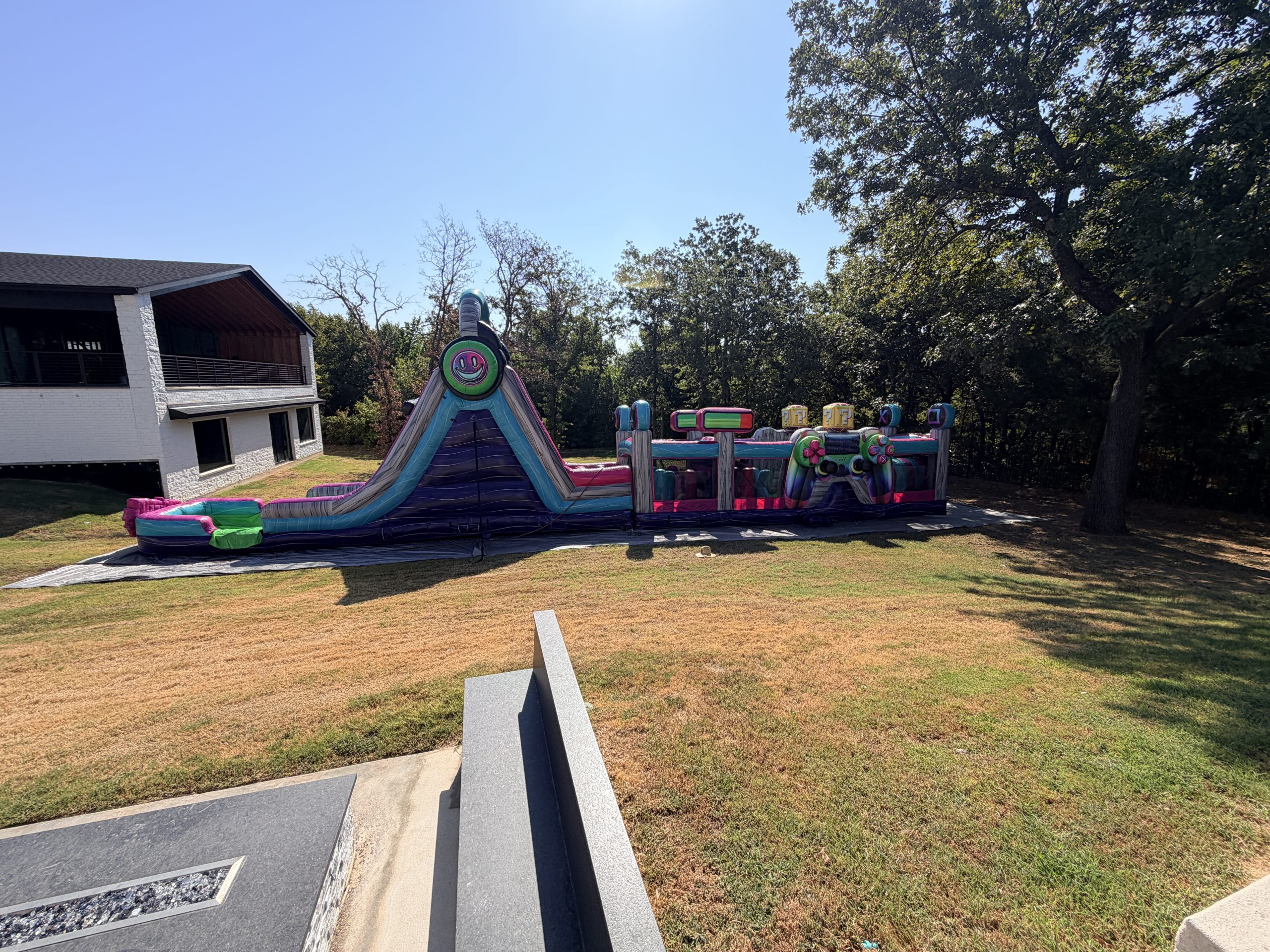
How Long Does It Take to Set Up a Bounce House?
For a standard backyard bounce house, plan on 20 to 30 minutes from the time the trailer stops to the time kids can climb in. Larger combo units, water slides, and yards that are hard to reach can push that to 45 minutes or an hour. Very little of that is actual inflation. The blower fills the unit in a few minutes. The rest is carrying, positioning, and anchoring.
What actually happens on delivery day
The order barely changes from job to job. Knowing the sequence explains why one setup is quick and the next one drags.
Walking the site
Before anything comes off the trailer, the crew looks at where the unit is going. They check overhead clearance for branches, wires and eaves. They look for sprinkler heads, tree roots, sharp rocks, fire ant mounds and anything the dog left behind. They find the outlet and work out the cord run. This takes a few minutes and it is the stage that saves the most time later.
Moving the unit into place
This is the part most people underestimate. A rolled residential bounce house is heavy and awkward, and a large combo or slide is heavier still. What matters is not the size of the unit so much as the path to the yard: how far from the truck, how wide the gate, whether there are stairs, whether the ground is soft. A gate under three feet wide, a steep side yard, or a long carry around the block can add fifteen minutes on its own.
Laying the ground cover
A tarp goes down first, both to protect the vinyl from whatever is on the ground and to keep the underside cleaner for the next family. The crew unrolls the unit on top of it and squares it up with the space, leaving clearance on every side so nobody lands against a fence.
Inflation
The fastest stage by far. Once the blower is connected and the deflation tubes are tied off, most residential units stand up in a few minutes. Larger units and multi-chamber slides take longer, and some need two blowers running at once.
Anchoring
On grass, that means long metal stakes driven at an angle through every anchor point, all the way down. On concrete, a driveway, or turf over a compacted base, it means heavy sandbags or water weights on every point instead. Nobody should rush this stage. Anchoring is what keeps an inflatable on the ground in a gust, and skipping points is how people get hurt.
Water hookup, if it is a wet unit
Water slides add a step. The crew runs a hose from your spigot, checks the spray, and makes sure runoff is going somewhere sensible rather than into a neighbor’s flower bed. Add roughly ten minutes.
The walkthrough
Last, someone should show you the blower, the plug, which breaker it is on, what to do if the unit starts to sag, the rider rules, and the plan if the weather turns. If a delivery ends without that conversation, ask for it before the crew leaves.
What makes setup faster
- A short, flat, clear path from the driveway to the setup spot
- A gate propped open before the crew arrives
- Pets inside and the yard picked up ahead of time
- Grass rather than a hard surface, since staking is quicker than hauling sandbags
- A working outlet within an easy cord run
- Someone home who can point at the exact spot without a debate
What slows it down
- Narrow gates, stairs, steep slopes or a long carry from the street
- Hard, dry ground that fights the stakes, which is common here in late summer
- Sprinkler lines or a septic field that force a change of position
- Wet, muddy grass
- No outlet in range, which means solving power before anything else happens
- Traffic and a difficult setup earlier in the day
- Multiple units, which roughly multiply the whole process
When to schedule delivery
Ask for the unit to be up and running at least an hour before guests arrive, and more if you can manage it. Most companies deliver in a window rather than at an exact minute, because a flat tire or a stubborn setup earlier in the day pushes everything behind it. An hour of buffer turns a late arrival into a non-event.
Early delivery is usually cheap or free and almost always worth it. On a busy spring or fall Saturday, plenty of companies will drop units off first thing in the morning for an afternoon party, and it costs you nothing but a bounce house sitting quietly in the yard. If you want it up before the sun is high, say so when you book rather than the day before.
One more thing to plan around. An inflatable is not something you casually move. Once it is anchored, it stays there. Decide where the tables, the cake and the shade are going before the crew stakes it down.
Takedown is about the same
Pack-up runs close to setup time, sometimes a little less. The unit has to be deflated, swept out, wiped down, folded, rolled and hauled back to the truck. A wet slide takes longer because it needs to be drained first. Build that into your evening if you have neighbors who care about noise, and tell your rental company if there is a hard cutoff at your venue.
The practical takeaway
Twenty to thirty minutes is normal for one dry residential unit on grass with easy access. Everything that adds distance, obstacles, weight or water adds time. Clear the path, unlock the gate, know where your outlet is, and book delivery for at least an hour before the party starts. Do that and setup becomes the least interesting part of your day, which is exactly what you want it to be.
InflatableTX is a family-run rental company serving North DFW, including The Colony, Frisco, Plano, Lewisville, Little Elm, Denton, Flower Mound and Carrollton. If you are working out timing for a party, you can see what we have available and plan the day around it.